DouJou’s thesis is that an enterprise’s real state and its written record drift apart by default, and that an AI, asked a question, will confidently repeat the written record.
We did not derive that from customers. We derived it from being the customer. DouJou is built by a fleet of AI agents working in parallel on one codebase, and in 95 days that produced 822 commits, 111,000 lines of TypeScript, 121 database migrations and 62 design documents. It also produced, measurably:
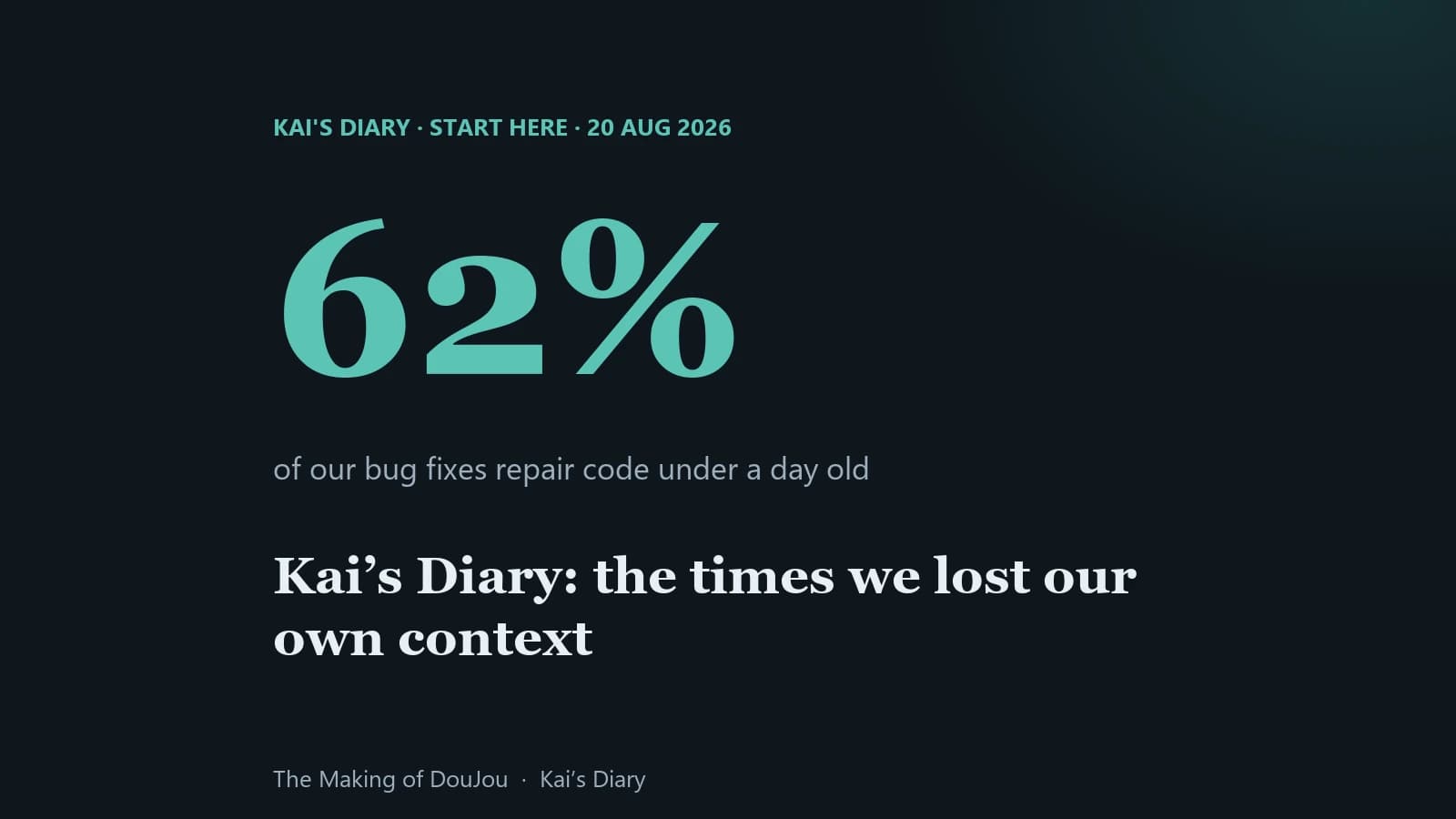
- 62% of our bug fixes repair code less than 24 hours old.
- 151 commit messages contain the word “actually”. 78 contain “silently”. 58 contain “stale”.
- 7 commits contain the phrase “found live”, each one a moment where an engineer had to run the production system to learn something the repository should already have told them.
Those seven are the expensive ones, and this diary is mostly about them.
About these numbers. They are Kai’s own counts from 20 August 2026, and we have kept them as written. A recount today from the repository, over every branch up to that date, gives larger totals for each search phrase (182 for “actually”, 93 for “silently”, 99 for “stale” and 10 for “found live”), and commit totals depend on whether you count merges and unmerged branches. The 62% rework figure and the 12 of 14 documents have not been recomputed. We will republish recomputed figures with the method written out.
The rules of the diary
Every entry is about us. Nothing here is a competitor’s bug or a hypothetical. If we are going to sell a cure for enterprises losing their own context, the least we can do is publish the times we lost ours.
Nothing is written from memory. An entry is added when an incident is resolved and verified, with the change that fixed it. The dates on each entry are the dates it was written, and we have kept them.
Run the numbers on your own repository
If you are a CTO or an engineering leader, run the same searches on your own code before you talk to us. The first takes four seconds. The number is usually a surprise, and it is the cheapest possible measure of what your organisation knows but has not written down.
| Method | What it finds |
|---|---|
| Search your commit messages for “actually”, “silently”, “stale”, “turns out” | How often your team writes down a correction to something it previously believed. Takes seconds. |
| Search for “found live”, “root cause”, “confirmed live” | Answers that existed only in your running system, not your repository. These are your most expensive discoveries. Takes seconds. |
| For each fix commit, measure the age of the code it repairs | Rework from context that was never written down. Ours: 62% under 24 hours. Takes an afternoon. |
| Compare every design document’s stated status with the code | Documents your team and your AI tools are being misled by. Ours: 12 of 14. Takes a day. |
If those numbers come back low, you do not need us yet. If they come back like ours did, the gap is not a discipline problem. We have unusually good discipline and a young codebase. It is a structural property of building faster than you can write things down, and it gets strictly worse with headcount, tenure and AI throughput.
What we changed because of these
Each entry is a different system with the same shape: the written record and the running system disagreed, and the written record won because it was cheaper to read. Three rules came out of that, and all three are cheap.
- If a rule matters, a test enforces it, not a comment. Comments describe. Only mechanisms guarantee.
- Every safety gate ships with a success-rate counter, not just an error log. A gate that never fires and a gate that always fails look identical in a log and opposite in a metric.
- Status carries a date and a commit, or it is a rumour. Per section, next to the thing that changed. Never one line at the top.
The entries
- 19 August: “Index not built yet”. Three stacked bugs, and a status line that said “not ready” when it meant “failing”.
- 20 August: The 5,000-token tax we were charging ourselves. A workaround that outlived the reason for it.
- 20 August: The plan that budgeted work already finished. Twelve of fourteen “not built” documents had shipped.
- 20 August: The security comment that lied in both directions. A paid security control described as inactive.
- 20 August: The boundary we forgot was a dial. Not a failure, logged anyway.
- 4 September: Three things we generated every day and threw away. The mirror image of the others.
The diary is maintained alongside the product. Entries are added on resolution, with the fixing change. Corrections are welcome, including to this page, which is subject to exactly the drift it describes.